My Article in New Issue of Skeptical Inquirer

The new Nov/Dec issue of Skeptical Inquirer (http://bit.ly/3Jv4tKU) has my article, “Teaching Critical Thinking in Authoritarian Cultures” (p. 8). While most articles are free, not all are available to nonsubscribers. Unfortunately, mine is one of them. But check out the rest of the magazine for some great reading you won’t find elsewhere. A subscription is very reasonable.

Lecture on Argument Mapping as a Game

The Association for Informal Logic and Critical Thinkingis thrilled to announce the next session of:

The AILACT Speakers Forum

November 21, 11:00 US Eastern Time  Please note this special date!
Zoom Link:https://wisconsin-edu.zoom.us/j/7153464115

Better Disagreement through Simplified Argument Mapping Disguised as a Game

        Steve Franconeri

        Professor 

        Visual Thinking Laboratory

        Department of Psychology

        Northwestern University

His research is on how well-designed visual displays (charts, slides, and diagrams) can help people think and communicate better.

Abstract:  
Point Taken (https://pointtaken.social/) is Franconeri’s kitchen-table argumentation/collaboration game, designed to create clear and calm disagreements, combining the best prescriptions from conflict resolution and critical thinking. Steve will discuss and demonstrate the game, and then enthusiastically ask for your feedback on new and possible mechanics. Events will be recorded and archived on the AILACT YouTube channel:https://www.youtube.com/@ailactvideos

Please join us and please forward this on to others

If you have questions, please contact Kevin Possin directly at kpossin@winona.edu

CALL FOR PROPOSALS:  Please consider being a speaker by sending an abstract of your topic to:  

Frank Fair [psy_fkf@SHSU.EDU] or Dona Warren [dwarren@uwsp.edu]

Next Forum:

The AILACT Speakers Forum will return for a Spring season in February 2026

Hear From an Expert on AI August 1 (1pm ET)

“I’d Rather Talk to an AI”: Examining the Moral Risks of Outsourcing Belief Revision to ChatGPT

Presented by Martina Orlandi, Assistant Professor in the Applied Artificial Intelligence Program at Trent University Durham, Canada.

Convincing people that their beliefs are unwarranted is a notoriously challenging task. Granted that nobody enjoys being lectured, the culprit is that individuals often have non-epistemic interests that motivate them to hold onto certain beliefs. This is the case of conspiracy theorists. The standard view in both psychology and philosophy argues that conspiracy theorists are drawn to conspiracy theories for non-epistemic reasons and that reiterating the evidence not only is insufficient for belief revision, but it can also have a boomerang effect (Douglas et al. 2017; Horne at al. 2015).
      However, in April 2024 a comprehensive study from a group of psychologists at MIT has challenged this received wisdom and showed a surprising result: that while individuals struggle to persuade conspiracy theorists that they are wrong, ChatGPT can successfully change their minds by engaging in an evidence-based dialogue (Costello et al. 2024). What’s more, this change seems to be durable and to last for months.
      What should we, philosophers, make of these results? In this talk, I examine the philosophical import of outsourcing belief revision to AI. Insofar as abandoning false beliefs is epistemically rational, ChatGPT seems to bring about positive consequences by leading conspiracy theorists to revise their beliefs in light of factual evidence. However, I argue that outsourcing belief revision to AI also carries ethical risks by undermining moral growth. For example, when it comes to morally loaded conspiracy theories that target particular segments of the population (like those that drive distrust in scientists, or target vulnerable minorities, etc.), reconciling with factual beliefs can also restore trust in those targets, thus bringing about positive collective consequences by strengthening the social fabric. But this can only occur when true beliefs are delivered by other persons. Outsourcing belief revision to ChatGPT necessarily eradicates such positive returns because it undermines this relational benefit.

So You Like to Argue? Here’s Your Chance

Call for Abstracts – Arguing for Sport

Formal debate has been a staple of fostering competency in critical thinking since … well, Plato’s time at least. By now, there are dozens of styles, with varying degrees of adversariality, conditions for winning and topical constraints. To many students, debate was a life-changing experience that had a lasting impact on their approach to reasoning and argumentation generally.

In addition to a continuous interest in debate as a teaching method among practitioners at high schools and universities, we have also seen a recent uptick in interest in the practice from argumentation theorists working in vastly different traditions, examples of which are the work that the ADAB team at Ibn Haldon University have done on the Islamic Munazara tradition, and the recent 2nd International Conference on Debate and Dialogue in Qatar.  

We therefore believe that it is time to update our discussion on the merits and disadvantages of using debate to teach critical thinking. We welcome submissions from all academic disciplines on topics concerning the role of all types of formally structured debate in critical thinking and argumentation education./more

Read more: So You Like to Argue? Here’s Your Chance

Possible Topics Include: The merit of arguing according to explicit rules; adversarial vs. cooperative approaches; argument design and debate design; training devil’s advocacy through debate; debate practices in different cultures; debate as training for the job market; debate and legal reasoning; the history of debate as education; debate styles (e.g. Ethics Bowl, CX Debate, Munazara, Lincoln-Douglas etc.).

Details

THIS WORKSHOP IS ONLINE

Five papers will be accepted for presentation at the workshop based on peer-reviewed abstracts.  Each paper will be assigned a student commentator. For this reason, papers need to be submitted at a minimum two weeks before the presentation date to allow commentators enough time to formulate their comments.

Presenters will have thirty minutes to present their papers. Commentators will have ten minutes to comment. While papers will only be presented in English, we encourage second language speakers to take advantage of this opportunity to try preparing and presenting in English with an understanding and compassionate audience.

Application

To apply, please send an abstract of 250-300 words to fuehrer@uleth.ca by August 1, 2025. Completed papers should be no more than 8000 words excluding notes and bibliography.

If you are a student interested in being a commentator, please send an email with a list of your credentials, including the program you are enrolled in, and outlining your affiliation with argumentation.

Important Dates

– August 1, 2025 – Abstracts due

– January 9, 2026 – Papers due

– January 23, 2026 – Workshop

Sincerely,

Nathan Fuehrer, Graduate Student, University of Lethbridge

fuehrer@uleth.ca

July 4th lecture 1pm ET by Christoph Lumer

Prof. Dr. Christoph Lumer will speak about A Welfare Ethics of Argumentation.

Christoph Lumer is a full professor of moral philosophy at the University of Siena. He received his doctorate from the University of Münster (Germany), was a researcher and then associate professor of philosophy at the University of Osnabrück (Germany); since 2002 he has been professor at the University of Siena.

His main fields of research are: practical philosophy: normative and metaethics, environmental ethics, action theory, theory of practical rationality; theoretical philosophy: argumentation theory, metaphilosophy.

Go here https://www.argnet.org/ethics-of-arg-speakers.html for more information about Dr. Lumer. Here is the list of abstracts for this year: https://www.argnet.org/ethics-of-arg.

You can watch past talks on our youtube channel: https://www.youtube.com/channel/UCF50_BXQYXwcqFfLdXav5rg

IF YOU WOULD LIKE TO SEE A TALK, PLEASE EMAIL Katharina.stevens@uleth.ca.

“Psychological Inoculation Against Misinformation”

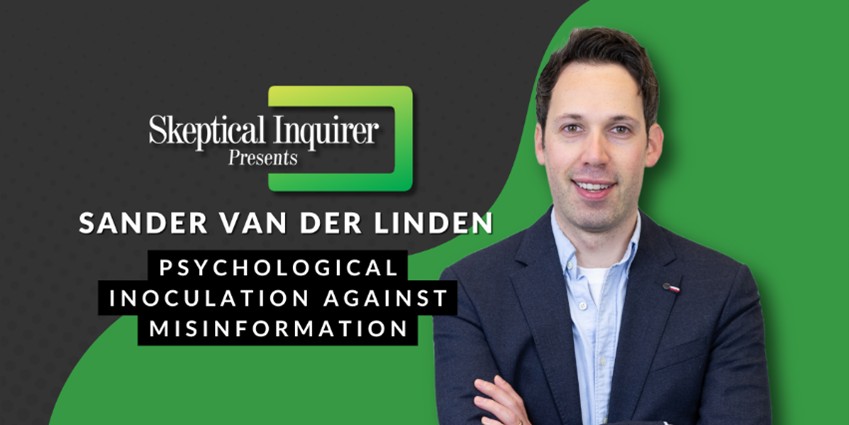
Save 7pm ET June 28, 2025, to watch Professor Sander van der Linden as he describes the lab and field studies into the process called “prebunking,” which van der Linden says helps people cultivate cognitive antibodies in both simulated and real social media environments. He’ll also detail several interventions—developed and evaluated with public health authorities and technology companies—to help people around the world recognize and resist unwanted attempts to influence and mislead. You must register in advance to attend this free event: Register Now

Much like a viral contagion, misinformation can spread rapidly from one mind to another. Moreover, once lodged in memory, falsehoods are difficult to correct. Inoculation theory offers a natural basis for developing a psychological “vaccine” against the spread of fake news and misinformation. Is it possible to pre-emptively “immunize” millions of people against disinformation by pre-exposing them to severely weakened doses of the techniques that underlie its production?

Sander van der Linden, PhD, is a professor of Social Psychology in Society and Director of the Cambridge Social Decision-Making Lab in the Department of Psychology at the University of Cambridge. He has won numerous awards for his research on human judgment, communication, and decision making. He codeveloped the award-winning fake news game “Bad News” and regularly advises governments, public health authorities, and social media companies on how to combat the spread of misinformation.

Special Issue about Critical Thinking

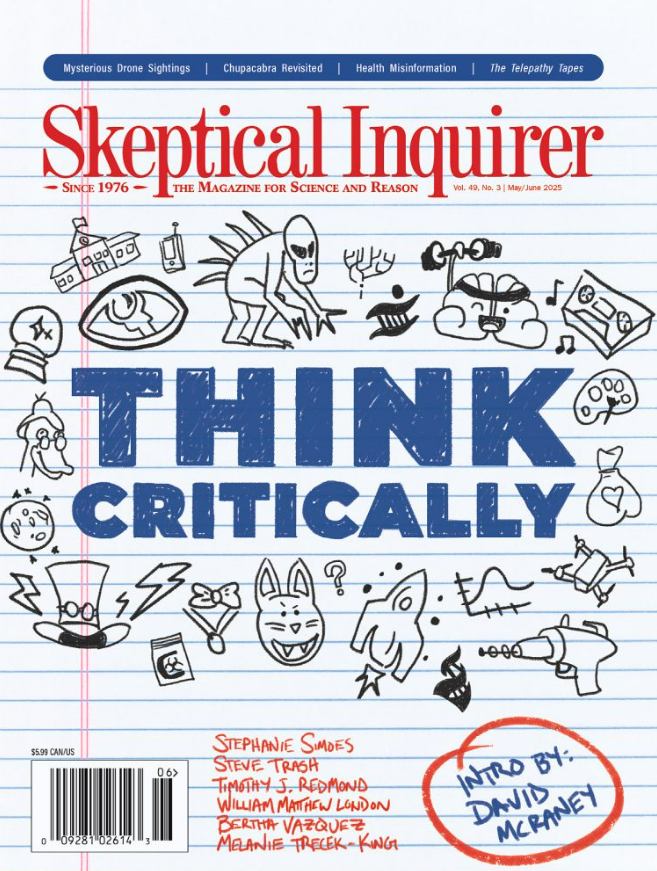
I subscribe to Skeptical Inquirer: The Magazine for Science and Reason, a bi-monthly publication. It’s been around since 1976. Consider subscribing. It’s a bargain at $2.80/issue and $19.95/year for digital+print. My article about teaching critical thinking in authoritarian cultures is coming out in a few months. Here’s the link to this month’s issue with several free articles: https://skepticalinquirer.org/volume/no-3-vol-49/. Why not submit your own article to Stephen Hupp, the editor?He’d love to hear your thoughts about this and future issues too.

Upcoming Talk on Critical Thinking

The Association of Informal Logic and Critical Thinking (AILACT) will host a talk by Dale Hample (U. Maryland), The Global Presence of Civility While Arguing, May 2, 1pm Eastern. Here is his description:

“In company with a number of scholars, I have spent more than ten years collecting and reporting data on how people orient to the prospect and experience of interpersonal argument.  We have results from about twenty nations, with repeated data collections in several of them.  We use (translated) surveys to gather people’s self-reports about their motivations for arguing or not, their understandings of what is going on when they do argue, and their emotional experience with interpersonal arguing.  All these categories of interest have multiple instruments that add detail to the general notions of motivation, understanding, and feelings.  One of those instruments is called civility and is formed from items that originally emerged from research done by Pam and Bill Benoit several decades ago.
                In this talk, I begin by explaining the operational definition of civility used in the research.  Next I make an effort to connect the conceptual elements of the measurement scales to various virtues associated with ethical arguing.  Then I move on to discuss some of the results of the global project, showing how civility is associated with various of the other measurements.  This is intended to show civility’s place in the whole inventory of motivations, understandings, and feelings about arguing face to face with another person, as well as the ethical implications of arguing with or without civility.”

You will be able to see the list of abstracts for this year under: 
https://www.argnet.org/ethics-of-arg.

You will also find information about our upcoming speaker. You can also watch past talks on our YouTube channel: https://www.youtube.com/channel/UCF50_BXQYXwcqFfLdXav5rg.


Check out this lecture on Friday 4/11/25 11am EDT:

Friendly Critical Thinking: Replacing Domination with Collaboration

by Dr. M. Neil Browne

Zoom link: https://wisconsin-edu.zoom.us/j/7153464115

Retired after 53 years teaching critical thinking at Bowling Green University and consulting with dozens of universities, corporations, and governmental agencies, all seeking, as we all are, better beliefs, conclusions, and decisions.

Table of Contents for Presentation:

1) Toward what end do we encourage critical thinking?

2) How does Aristotle’s understanding of friendship push us to teach critical thinking 

in a particular fashion? 

3) How does the difference between a scout and a sniper provide alternative visions 

of the purpose of critical thinking?  The difference between an adversarial legal 

system and mediation?  A sports event and a research team?

4) How can critical thinking be encountered as a joint experience, permitting each 

participant in an exchange to teach AND learn? 

5) What is the sound and the look of a friendly critical thinking?

Events will be recorded and archived on the AILACT YouTube channel:  https://www.youtube.com/@ailactvideos

Feb 14 Lecture: Critical Thinking Skills Among Students

The AILACT Speakers Forum

February 14, 2025, 11:00 US Eastern Time
Zoom Link: https://wisconsin-edu.zoom.us/j/7153464115

“Mindware: A New Way of Thinking about Critical Thinking”

By Prof. John Eigenauer

Abstract:  

The general lack of critical thinking skills among students and the populace at large has long been lamented and substantiated. Books are legion about the brain’s fallibility, and our tendency toward tribalism, heuristic thinking, emotional responses and biases. But what if these flaws, however inherent to the human condition, reflected a lack of more effective thinking tools and not an insurmountable, biologically intractable condition? Using Keith Stanovich’s model of “mindware,” it is possible to reframe critical thinking as the process of using discrete, learned skills to overcome our tendency to fall back on System One thinking. This modular approach treats critical thinking as a set of clearly defined and easily mastered skills that, when taken together, can lead to the formation of habits of mind that define consistent “critical thinkers.”
John Eigenauer is an intellectual historian and professor of philosophy at Taft College in California. He holds a doctorate in Interdisciplinary Studies from Syracuse University. His work has been published in a variety of publications including the International Journal of Educational ReformThe HistorianThe Harvard Theological ReviewHistory of Intellectual CultureThe Journal of IntelligenceThinking Skills and Creativity, and The International Journal of Educational Reform. He has spoken internationally on human rationality and offers workshops and seminars on the pedagogy of critical thinking. His book, Paris and the Birth of Public Knowledge, is available online.
Events will be recorded and archived on the AILACT YouTube channel:
https://www.youtube.com/@ailactvideos

Caitlin Johnstone

Daily Writings About The End Of Illusions

LET'S MOSEY ON

A Moving Account

Straw Clay Wood

Natural Building with Michael G. Smith

Seattle Muses

Conscious Fashion Studio

QA Productions

Ebooks = Real Books